Showing posts with label fantasy. Show all posts

Friday, June 25, 2010

A bit of news and some wonderful links

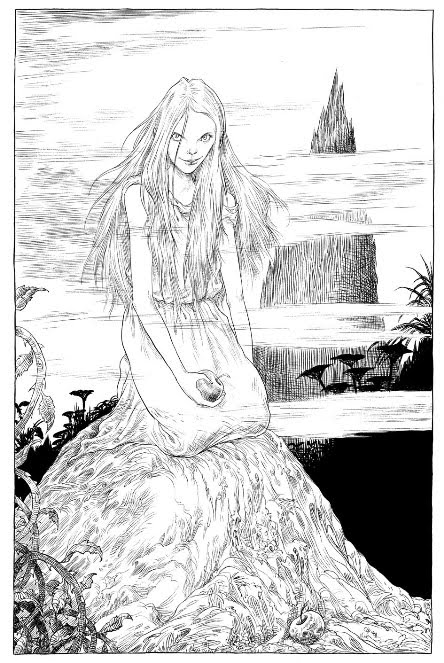
For those of you who, a couple of posts ago, said "Huh? Who's Neil Gaiman?", I have this piece of news: Mr. G is now the only author to be awarded both the CILIP Carnegie Medal and the Newbery Medal for the same book. The medals are awarded in the UK and the US respectively, for the best children's book of the year. This year's winner for both was The Graveyard Book. You can read more here.

The picture shown here is one of my favourite illustrations from the book.

FYI, he has been the recipient of numerous awards in the past, including the World Fantasy Award (the first author to receive it for a comic) and the Hugo Award for Best Novel.


Also, I thought it about time that I shared a wonderful ebook link I've found: make sure you check out Inkmesh. It's a search engine for ebooks. It's invaluable for finding those ebooks which are difficult to track down- last night I finally found L.M. Montgomery's Emily trilogy in an electronic format. It also lists prices and available formats alongside each site which supplies the ebook, cutting down on time-consuming online searches.

It's so useful, in fact, that I've added it to my page of (Actually) Useful book links.

Tuesday, March 23, 2010

Stardust: Child vs. Adult

I've just been listening to a podcast found here about Neil Gaiman's Stardust. Most of the discussion in the podcast revolves around what makes the book a 'fairytale for adults'.

Stardust, as you know, is one of my favourite books. Gaiman describes the premise of the book:

"I wanted a young man who would set out on a quest - in this case a romantic quest, for the heart of Victoria Forester, the loveliest girl in his village. The village was somewhere in England, and was called Wall, after the wall that runs beside it, a dull-looking wall in a normal-looking meadow. And on the other side of the wall was Faerie - Faerie as a place or as a quality, rather than as a posh way of spelling fairy. Our hero would promise to bring back a fallen star, one that had fallen on the far side of the wall.

"And the star, I knew, would not, when he found it, be a lump of metallic rock. It would be a young woman with a broken leg, in a poor temper, with no desire to be dragged halfway across the world and presented to anyone's girlfriend."

In the same article, Gaiman mentions that he loved The Princess Bride when he was young, and wrote Stardust with the wish of creating another story that was "unapologetically a fairytale, and just as unapologetically for adults."

Much of the podcast discussion revolves around the single sex scene and the single swear word found in Stardust. Are these what make the novel one for adults? Or are they just the elements which make adults able to claim a fairytale as their own without embarrassment?

Monday, March 22, 2010

A new favourite

I blogged about my favourite books here, but alas, the list is now out of date. I've added Good Omens, by Terry Pratchett and Neil Gaiman, to my list of favourite-ever books.

I wrote about Good Omens here. I really can't praise the book highly enough.

And I am rather excited to have found some wonderful fan art, here on deviantART. Do yourself a favour and check it out. It's beautiful art, and it's an excellent recommendation for the book.


View on fishpond: Good Omens

Friday, February 26, 2010

Characters to hate

I've dealt with my favourite characters, but what about the least favourite?

I often find that the characters I truly despise aren't the villains and the supervillains- there is pleasure in disliking these, they are literary devices and they are there to be disliked. But what about the characters towards whom I'm supposed to feel sympathetic, and simply don't? Those, I really cannot forgive.


1. Heathcliff, Wuthering Heights, by Emily Brontë – there seems to be nothing to Heathcliff’s personality but abuse and manipulation. He was bent on destroying the lives of all he knew, including the woman he was supposed to love. Where is the heroism in that?

2. David Meredith, My Brother Jack, by George Johnston – David’s self-serving morality never won any points with me. Even worse, he recognized his own failures and refused to do anything about them.

3. Queen Jadis, The Magician’s Nephew, by C.S. Lewis – In The Lion, the Witch and the Wardrobe, the White Witch is something of a literary device, a villain, not truly despicable. But before she became the White Witch, Jadis was a Queen who, even in the prime of her very human youth and beauty, thought more of her own power than she did of her people.

4. Lady Macbeth, Macbeth, by Shakespeare – Enough said.

5. Captain Kennit, The Liveship Traders Trilogy, by Robin Hobb – Kennit is pretty much a pirate version of Heathcliff. I will concede to Robin Hobb, however, that Kennit is a masterfully complex character, the most difficult on this list to hate.


As you might gather, I have no truck with the Byronic Hero. Life throws terrible things at all of us. Being ‘damaged’ is never an excuse for abuse, manipulation or compulsive lying. The Byronic Hero is a large part of the reason I avoid many classics, and the reason I refuse to read Twilight.

I do, however, have quite a soft spot for the antihero, who is different.

Saturday, January 30, 2010

Drawing Down the Moon


Have I mentioned before that I absolutely adore fantasy art?

Two imports arrived for me this week at work (I work in a bookshop), and I literally jumped up and down in my excitement.

The first was a collection of Arthur Rackham's illustrations, which I'm sure I'll mention again once I've had a chance to look at it. The second was Drawing Down the Moon: The Art of Charles Vess. The book is full of gorgeous fantasy illustrations and contains commentary from Charles Vess himself.

I was very interested to read: "After college, when I returned to the 'real world,' I had to struggle for many years to regain that lost, individual sense of whimsical fantasy that those school years tried to squelch." I hope the same doesn't happen to my writing.

Tuesday, January 26, 2010

This is my favourite book in all the world

I'm currently rereading The Princess Bride, and I'd forgotten how much I loved it. Actually I'm going to spend my whole year loving it (I hope), because I get to write my Honours thesis on it. I'm a little excited about the project.

Anyway, rereading one of my favourite books made me realize that I've never shared my favourites on here. So, here they are:

The Princess Bride by William Goldman
I love this book because of its playfulness and its truth. I love so many of the characters- Inigo, the vengeful Spaniard, is my favourite. How can you not love the dialogue? (Much of which is in the film. Don't tell me you haven't seen the film. You'll break my heart.) And how can you not love Goldman for continually taking the piss out of his own work?
This book is pure satire, in all its sarcastic, entertaining glory.
First line: "This is my favourite book in all the world, though I have never read it."

The Emily series by L.M. Montgomery
I first read these when I was seven years old. If there are any books which define me, these are it. I quote these books continually, I've internalised them. They're by the author of Anne of Green Gables, but where Anne is flamboyant and loud, Emily is dreamy and intense. She lives in a world where fairies are always seconds away and words shape our existence.
Quote: "there is something BEYOND words--any words--all words--something that always escapes you when you try to grasp it--and yet leaves something in your hand which you wouldn't have had if you hadn't reached for it."

The Liveship Traders trilogy by Robin Hobb
I have never met characters who seemed more real. They step off the page. They learn, they grow, they ache. Robin Hobb allows her characters to go through things most authors would cringe at, and she allows them to be truly flawed (no 'token flaws' here).
And whaddayaknow? Their confused and flawed actions shape history in ways that you couldn't have guessed, yet seem just as real and inevitable as any human history.
Epic fantasy which is entitled to take itself seriously.

Girl in Hyacinth Blue by Susan Vreeland
This book is a collection of short stories about a single painting. A beautiful exploration of the ways in which art touches us, changes us and commemorates our passions. Girl in Hyacinth Blue gives us the history of a painting (possibly a Vermeer) through the lives of the people who admired its beauty, from the man who destroyed it to the girl who posed for it.

Stardust by Neil Gaiman and Charles Vess
Sparkling and funny. Fantastical and unsettling. Brilliant.


Thursday, December 10, 2009

Highlights '09

I'm subscribed to quite a few book blogs and book news feeds. At this time of year, a lot of 'best of ' and 'highlights' lists start coming through, pointing readers to the best books of the year. But the problem with book news is that it's all about new realeases. I started reading books towards the end of the 20th Century- I have the whole history of print to catch up on!

So these are (some of) the highlights of my '09 reading:

January - four weeks off in Toowoomba and Brisbane
   -The History of Western Philosophy, Bertrand Russell (1946)
     A fascinating look at a fascinating topic
  -The Amazing Maurice and His Educated Rodents, Terry Pratchett (2001)
     A magically intelligent cat and clan of rats figure there's always money to be made in faking rat plagues.

March-April - Semester 1
   -Beginning Logic, E. J. Lemmon (1965)
     An excellent guide to formal logic. I read it for uni, and it rocked my socks!

March 31- I meet Shaun Tan and a friend leaves the country
   -The Arrival, Shaun Tan (2006)
     A gorgeous graphic novel about the strangeness and beauty of immigration. I cried.

June - cruising on the Nile in Egypt
   -I was reading, but I don't quite remember what. The view was distracting me. =P

June/July - London & Oxford, England; and Wicklow, Ireland
   -The Inkworld trilogy, Cornelia Funke (2003, 2005, 2007)
     Because you have to read fantasy in Oxford.

July - a very long flight home
   -The Ghost, Robert Harris (2007)
     A surprisingly engaging modern thriller from a historical novelist.

August-October - Semester 2
   -The Graveyard Book, Neil Gaiman (2008)
     Brilliant. =)
   -The Magicians, Lev Grossman (2009)
     Equally brilliant. =)

mid-September - an awful sickness strikes
   -Sense and Sensibility, Jane Austen (1811)
     Thus completing my aim to read all of Austen's novels.

November-December - mixing up my reading habits
   -Preludes and Nocturnes, Neil Gaiman (1988/1989)
     The first installment of the classic Sandman comics. An excellent read.
   -Good Omens, Neil Gaiman and Terry Pratchett (1990)
     Read it.

(As always, I've posted links to authors' sites where possible. It's not my fault if their sites aren't helpful. Where these weren't available, I've posted links to the best information I can find about the book. Sometimes this means Amazon.)

Wednesday, November 11, 2009

Magicians and Graveyards

I mentioned Lev Grossman's brilliant The Magicians some time ago. Well, here is an interview of Grossman in which he discusses his book, among other things (e.g.; the disappointment of the Harry Potter epilogue).

The book gives a lot of insight into the nature of fantasy novels and fantasy worlds. So does the interview. =)

Grossman also has an Time Magazine essay (written in 2005) entitled 'The Geek Shall Inherit the Earth', about the increasing coolness of geek culture. Neil Gaiman gets quoted, which always wins points with me. You can find the essay here.


Speaking of Neil, I just finished reading The Graveyard Book. What can I say? Neil is genius!

Wednesday, November 4, 2009

Graceling- a review

Graceling is a curiosity. The first few chapters were rather disappointing in their clichés, the flatness of the characters, the lack of original plot. I usually refuse to finish a book I’m not enjoying, but for some reason I stuck with this one. I was richly rewarded.

Graceling is author Kristin Cashore’s first novel, and simultaneously suffers the marks of inexperience whilst being an exceptional first novel.

This is what I will say of the first few chapters: the story is set in a rather typical medieval fantasy world with seven kingdoms and (surprise surprise) a few kings grappling for more power. The protagonist is Katsa, a feisty, bad-tempered girl who happens to have a supernatural knack (a ‘Grace’) for killing. Aside from her killing Grace, Katsa could be lifted straight out of a Tamora Pierce novel; she’s exactly that kind of hot blooded, strong young woman.

Wednesday, October 28, 2009

These are a Few of My Favourite Characters

I’m a bit baffled to see Harry Potter at the top of the list of UK children’s favourite book characters. Seriously, Harry? Hermione, sure. Ron, even. The Weasley twins, Hagrid, Luna. But not Harry. He’s such a whiney ass.

I was, however, quite pleased to see Charlie and Lola in the list.

You can see the whole list here.


Anyway, it got me thinking. Who are my favourite characters?

1. Emily Byrd Starr – the Emily series, L.M. Montgomery
2. Nuuskamuikkunen (pictured) – Moomintroll books, Tove Jansson
3. Inigo Montoya – The Princess Bride, William Goldman
4. Fitzwilliam Darcy – Pride & Prejudice, the divine Ms. Austen
5. Peregrin “Pippin” Took – The Lord of the Rings, J.R.R. Tolkien
6. Althea Vestrit – The Liveship Traders trilogy, Robin Hobb
7. Wintrow Vestrit – The Liveship Traders trilogy, Robin Hobb
8. Professor McGonagall – The Harry Potter series, J.K. Rowling
9. Mr. Bennet – Pride & Prejudice, Jane Austen
10. Mr. Carpenter – the Emily series, L.M. Montgomery

I wonder if it says anything about me that only three of my ten are female? Narrowly missing the cut are Teddy Kent, also from L.M. Montgomery’s Emily series, and Maurice, the streetwise, smart-talking alley cat from Terry Pratchett’s The Amazing Maurice and his Educated Rodents.

It's also interesting that a few of my favourite characters are from books that wouldn't even rate in my favourite books/series (e.g. Harry Potter), whilst other books which I adore (e.g. The Last Battle by C.S. Lewis) don't have any especially endearing (to me, anyway) characters.

Please leave your own lists in the comments section- I’d love to see them!

Monday, October 19, 2009

Fantasy and Philosophy


It happened when I was six. It was lunchtime at school, and we were acting out the narrative of a story we all knew (I can't remember what it was anymore), and this one boy just would not get his part right. I distinctly remember my frustration. I hit him over the head with the book (the one we were acting out), and thought 'I'd rather be reading The Lion, the Witch and the Wardrobe anyway.'

After that, I spent a lot of lunchtimes reading the Narnia chronicles. I was too young to understand that this was social outcast behaviour; I just genuinely preferred to be reading them and that was that.

I was six when I fell in love with fantasy.

I did, however, fervently deny being a fantasy buff until I was twenty. I was at university, taking a unit about fantasy fiction when it eventually clicked: You know, fantasy is a lot like philosophy.

The wonderful, the amazing thing about philosophy is that it's about clarity. Pick a topic, the kind of topic that is hugely important but which most people are vague about (when pressed, they will mumble something about gut feelings and 'just knowing' or 'everybody knows'). There are philosophers who have wrestled with it, separating concepts which most people conflate, applying logic, exposing fallacies, pinning down what we mean by certain terms, laying bare what it is that we really think. Clarity.

Beautiful. Clear. Complex, but sensical.

When you apply philosophy properly, you address old, familiar, confusing issues with clean, crisp, ordered thoughts and the issues become as clear as if they were brand new. Philosophy has a way of sweeping away the muck of familiarity and mistaken associations.

Then there's fantasy fiction. Any fiction, really, but especially fantasy fiction. Fantasy is always about the hugely-important-but-difficult-to-define things, but it deals with them through narrative. It presents them in all their muddled complexity, it acknowledges the human impossibility of understanding. It provides little paradigms, dancing around the real issues by presenting us with the points of view of flawed and limited characters. It involves messy and mistaken actions and prods at the big consequences of these.

But it does all of this in a way so unfamiliar, in a world so unlike ours, that in the confusion we see with clarity issues and ideas which, in our own lives, are obscured by their familiarity, their uncomfortable closeness to ourselves. Fantasy has a way of sweeping away the muck of familiarity and mistaken associations.

Now, I am unashamed to call myself a fantasy buff.

It's not about gaining a level of great enlightenment. It's about always understanding just a little better. It can be as hard-won as a difficult philosophical proof, or as easy as getting carried away by a story.
Monday, September 21, 2009

Easy Read = Trashy Novel ?


The brilliant Lev Grossman (author of The Magicians, a gritty fantasy novel I devoured in 24 hours a few weeks ago) on why good novels can be easy to read: "A good story is a dirty secret that we all share."


Read his article here.


Tales From Outer Suburbia


I have finally got round to buying Shaun Tan's Tales From Outer Suburbia, and it is a gorgeous book! As always, Shaun Tan's artwork is incredible! The book is a collection of short stories, all written and illustrated by Tan.

I have been a fan of Tan for some years. His illustrations make brilliant use of fantastical elements, showing the strangeness and absurdity of objects and places that we have come to think of as ordinary. In this book, Tan proves that he's a great writer too.

My favourite story so far is 'Distant Rain', which begins: "Have you ever wondered what happens to all the poems people write? The poems they never let anyone else read?"