I was excited to learn recently that Google ebooks has now made buying through local bookstores much, much easier. For reasons previously discussed on this blog, I am no fan of Amazon. I was sad to learn last year that my favourite source for ebooks, The Book Depository, had been purchased by Amazon.
Never fear! Google ebooks has teamed up with independent bookstores to give you both range AND the ability to support your friendly neighbourhood indy bookstore. I found out about this through Laura Miller, who wrote about it here. The ebooks are sourced from Google ebooks, but you buy through your favourite bookstore's website and they get a cut.
The idea is still catching on in Australia, but at present you can already support Australian businesses by buying your Google ebooks through Booktopia or Dymocks.
Don't forget, if you're looking for places to get ebooks in general, Project Gutenberg is your best source for free ebooks of out-of-print books, and Inkmesh can help you find tricky-to-find ebooks.
Showing posts with label e-books. Show all posts
Showing posts with label e-books. Show all posts
Monday, January 30, 2012


Saturday, November 27, 2010
Reblogging
This is how awesome thinking comes about. Collaboration.
The fascinating, wonderful Naja linked to my previous post about graphic novels via Tumblr. I met Naja in the course of my English degree. She kept cropping up in my classes, in those delicious English classes about children's lit and fairy tales which felt like cheating because it wasn't work to study these things, not really, it was fun.
Anyway, here's something Naja says in her blog about my blog which, by the way, you can read right here:
It's certainly not the most interesting thing she has to say (you really should read the whole blog) but I'm quoting it here because I relate to it. I have very little patience for long books, for wordy books, for overly literary books or for classics. I almost quit literature at uni after having to read Wuthering Heights in first semester, first year, but lucky for me I took a class on fantasy the following semester and fell back in love with books.
All this made me think about another blog I recently read, incidentally by Doc-in-Boots, the academic who runs all those classes on children's lit and fairy tales which Naja and I attended.
The fascinating, wonderful Naja linked to my previous post about graphic novels via Tumblr. I met Naja in the course of my English degree. She kept cropping up in my classes, in those delicious English classes about children's lit and fairy tales which felt like cheating because it wasn't work to study these things, not really, it was fun.
Anyway, here's something Naja says in her blog about my blog which, by the way, you can read right here:
Novels are only just a majority in my favourites collection, and sometimes I feel like a bad lit student for it, because I have such a short attention span and I much prefer WHAM POW PICTURES! to some weird snooty elite.
All this made me think about another blog I recently read, incidentally by Doc-in-Boots, the academic who runs all those classes on children's lit and fairy tales which Naja and I attended.
Wednesday, September 29, 2010
Your friendly neighbourhood e-bookstore
There's an article here about the impact of e-books on author royalties. It bothers me a little that the article focuses mainly on 'literary fiction', but let's set that aside for a moment. The following sentences caught my attention:
Call me optimistic, but I think that in time the book industry will grow into this new phase and we'll see the emergence of such stores online.
Unlike traditional bookstores, where a browsing customer might discover an unknown book set out on a table, e-bookstores generally aren't set up to allow readers to discover unknown authors, agents say. Brand-name authors with big marketing budgets behind them are having the greatest success thus far in the digital marketplace.Actually, not all 'traditional' bookstores are 'set up to allow readers to discover unknown authors. The bookstores set up for this are usually small (local) independent bookstores. E-bookstores aren't local, and at this early stage most aren't independent. E-books are mostly sold via the websites of well-known, established bookstores. I'd like to see an online equivalent of a local independent bookstore; an e-bookstore which displays little-known titles and has a unique layout. Has anyone seen one? I'd like to hear about it if you have.
Call me optimistic, but I think that in time the book industry will grow into this new phase and we'll see the emergence of such stores online.
Tuesday, August 17, 2010
NEEEEEEIL! (and also some links)
Just over a week ago I attended 'Graphic', a convention run by the Sydney Opera House. Neil Gaiman was present.
For those of you who weren't lucky enough to attend, here's a video of the reading Neil did on the Saturday night. His reading voice is just divine, but don't take my word for it. Check out the video.
I attended a panel discussion with Neil, Shaun Tan and Eddie Campbell the following day, and got to ask Neil a question I've been pondering a while. It was a wonderful weekend. =D
Now I'm back to study, and have found myself quite motivated to write by this rather old TIME interview of Neil and Joss Whedon (by none other than Lev Grossman).

In some unrelated thoughts, I've been thinking about how having an ereader changes my reading experience. Just this morning, a friend mentioned that he'd found an underlined sentence in a book I've loaned him. I've always been very aware of books as physical objects. I don't just read them, I use them. I love the portability of ebooks, but I do occasionally miss the ability to mark a page with a ticket stub or write my thoughts in the margins. And voila, I logged onto one of my favourite blogs today and found this link, in which Sam Jordison discusses books-as-archives.
For those of you who weren't lucky enough to attend, here's a video of the reading Neil did on the Saturday night. His reading voice is just divine, but don't take my word for it. Check out the video.
I attended a panel discussion with Neil, Shaun Tan and Eddie Campbell the following day, and got to ask Neil a question I've been pondering a while. It was a wonderful weekend. =D
Now I'm back to study, and have found myself quite motivated to write by this rather old TIME interview of Neil and Joss Whedon (by none other than Lev Grossman).

Friday, June 25, 2010
A bit of news and some wonderful links
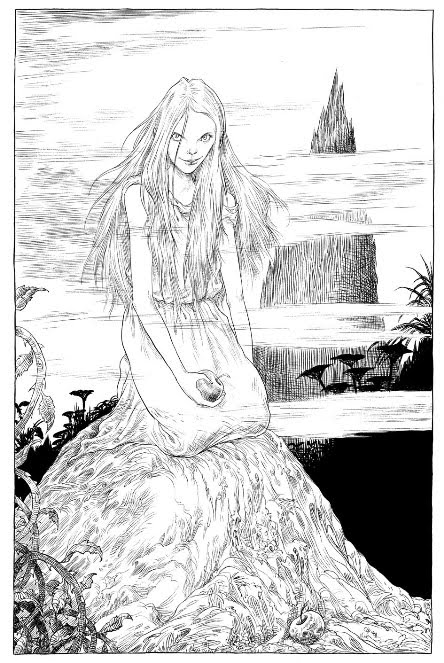 For those of you who, a couple of posts ago, said "Huh? Who's Neil Gaiman?", I have this piece of news: Mr. G is now the only author to be awarded both the CILIP Carnegie Medal and the Newbery Medal for the same book. The medals are awarded in the UK and the US respectively, for the best children's book of the year. This year's winner for both was The Graveyard Book. You can read more here.
The picture shown here is one of my favourite illustrations from the book.
FYI, he has been the recipient of numerous awards in the past, including the World Fantasy Award (the first author to receive it for a comic) and the Hugo Award for Best Novel.
Also, I thought it about time that I shared a wonderful ebook link I've found: make sure you check out Inkmesh. It's a search engine for ebooks. It's invaluable for finding those ebooks which are difficult to track down- last night I finally found L.M. Montgomery's Emily trilogy in an electronic format. It also lists prices and available formats alongside each site which supplies the ebook, cutting down on time-consuming online searches.
It's so useful, in fact, that I've added it to my page of (Actually) Useful book links.
Monday, May 24, 2010
Sony Reader Touch - my new toy
My Sony Reader (Model PRS 600) arrived in the mail a couple of weeks ago. I was terribly excited about receiving it, but completely unprepared for the resulting love affair. I know, I know! I am a book lover! This blog is, after all, entitled 'Paper and Ink and Glue'. But I want to be honest with you, and the truth is that I adore my ereader.
Friday, April 16, 2010
Some random thoughts
Why do most fiction authors fall into the first half of the alphabet? Or, to be precise, in A-M?
I've worked in books for eight years and as long as I can remember, three quarters of the fiction shelves in each workplace have been taken up by A-M, with N-Z squashed into the final quarter and dominated by Jodi Picoult and Wilbur Smith.
Is there some natural law which makes people with surnames beginning with A-M more talented? Do authors choose pseudonyms in the first half of the alphabet so that they will appear earlier in catalogues? Are there simply more surnames overall which begin with A-M? Or do book buyers scroll through lists of possible purchases starting at A and run out of money at N?
The biography section is evenly divided between A-L and M-Z. Every fiction section (general fiction, classics, speculative fiction) is skewed. I'd like to know why.
In other thoughts, now that I've decided to get myself a e-reader for study purposes I'm a bit frustrated to find that many of the text books I need are more expensive in e-book form than they are in paperback. It would be handy to carry all my text books around with me, but am I really willing to shell out an extra $20 per book?
I understand that the cost of producting e-books is nowhere near as low as most consumers estimate. Scott Westerfeld in his blog about Macmillan vs. Amazon explains:
"All discussions of this event will draw commenters who think they magically know how books should be priced, and who say there is no reason for electronic editions to be more than $9.99. A quick note to them: You don’t know what you’re talking about. Seriously, your back-of-the-envelope calculations are crap. The printing costs of a book are generally between 3% and 10% of list price. So in most cases, 10% should be your “first-printing” e-book discount, not 50%. That may seem weird to you, but that’s because all the cheap stuff on the internet is backlist (like Baen Books), subsidized/coerced (like Amazon), self-published (no editing or marketing costs), or promotional (like when I gave Uglies away for free). Yes, the “long tail” of backlist books may become very cheap, or free, but not the new stuff, which is what this discussion is all about."
But still. I don't want to pay more for an e-book. I'm a reluctant convert. I'm still getting used to the idea of having e-books.
Here's a bright idea: why don't publishers of text books offer hard-copy/e-book bundles? At, say, $10 more than the paperback price? Now that I'd be willing to pay for. I could highlight to my heart's content and carry around a light, easy reference tool.
Sunday, March 28, 2010
Argh! Or, The difficulties of purchasing an e-reader.
Despite my love for books of the paper and ink variety, I have decided to buy myself an ebook reader. I don't actually think I'll buy significantly less books. That is, I'll keep buying graphic novels, photographic books, picture books and books which are unavailable electronically or are cheaper as hard copies (there are more of those than you'd suspect).
What I will buy electronically are the books I would have previously bought as paperback fiction. And some of those, I suspect, I will go on to buy as hard copies (if I like them enough), because I am a compulsive collector.
Why buy an ebook reader, then?
- Portability
- The ability to carry study materials and notes
- The ability to make notes or highlight as I read even though I've left my pens and highlighters at home again
- The ability to search study materials and the notes I've made on them
 Something easy on the eyes (i.e. with a decent sized screen and E-ink technology, which rules out the iPad and anything smaller than 6 inches)
- Something which allows me to highlight and make notes as I read (Which rules out the beautiful green Cool-er)
- Something which isn't going to cost me more than $600 (which rules out the Irex models sold by Dymocks)
- Something which allows me to buy ebooks from any store I like without jumping through hoops (which rules out the Kindle)
- Something which doesn't punish me for living in Australia by making it almost impossible to register the product or purchase compatible ebooks (which rules out pretty much everything else)

The Sony Reader Touch Edition, which apparently is a bit difficult to procure books for. OR, the BeBook Neo, which hasn't been reviewed yet due to its April release date and has the misfortune of being $200 more expensive and looking a lot like an iPod.
Sigh.
Friday, February 26, 2010
Aesthetic value?

One of the primary arguments extended against e-books is that books, in their hard copies, have an aesthetic value that simply cannot be replicated electronically. The texture of the paper, the smell of the ink, the lush covers. I myself have extended this argument.
I was struck, however, by an odd thought when I visited my local village library on Monday. Going to this library is like stepping back in time. No computers, just cards which slip in and out of yellow pockets, and stamps. The second floor of this library is lined with old hardcovers, some exquisitely bound, some so faded along the cloth spines that it is impossible to read the titles.
Haven't we already lost much of the aesthetic value of books? What, truly, is the aesthetic value of a mass-market glued paperback when compared with a leatherbound hardcover with thick pages and hand-stitched binding?
On a trip to Europe last year, I was lucky enough to visit some amazing libraries. The Long Room of Trinity College, Dublin, was among them. It was stunning. It was full of beautiful books. I hope we'll always have beautiful books, that publishers will keep commissioning them and printers will keep printing them. But what have we really lost if mass-market paperbacks turn electronic?
Monday, February 15, 2010
Buying a better way
Something that matters a lot to me is finding a better way to buy. It's important to me to find fair trade or single origin (easily traced and therefore usually ethically sourced) coffee and chocolate. It's important for to me to buy clothes and jewelry that weren't made using sweat shops or other forms of exploitation.
The publishing industry is one in which large corporations make a lot of money and small, independent publishers struggle to make ends meet. It is a very old industry, currently in flux due to the rise of e-books and online giants such as Amazon. It is my belief Amazon has consistently put its own needs above those of readers and publishers, and furthermore has used its clout to bully publishers into submitting to this. For a brief list of controversies surrounding Amazon, see this.
Monopoly of an industry by a single online giant is good for nobody.
There is, however, a little-known Australian online retailer of books, fishpond. If future, if you want to buy books I've mentioned, I'll link you there.
Most of my readers are Australian, and so will benefit from free shipping for orders over $49, book prices listed in Australian dollars, and a guarantee that ordering from fishpond will cost Australian customers less than ordering from Amazon.
Furthermore, my conscience will be clear because I'll know that I've linked you to a site that respects the needs of publishers, authors and readers.
Sunday, February 7, 2010
E-textbooks
As much as I love paper and ink books, I must say I would have welcomed e-textbooks with open arms. Too bad they're coming too late for my undergrad years. I'd especially love access to such a resource this year, as my Honours thesis promises to have me carrying around mountains of books only relevant for a chapter here, a page there...
Well, perhaps an incentive to study postgrad.
Well, perhaps an incentive to study postgrad.
Tuesday, October 13, 2009
Hopelessly lame book alternatives
Laura Miller's discussion of video-book hybrids, found here, made me laugh. Her summary of the critiquing of new 'book' technologies is pretty accurate:
"Someone is called upon to say the sky is falling and to scold book publishers for being behind the times ... Then someone stuffier is summoned to detect the imminent fall of Western Civilization presaged by people's unwillingness to read great literature anymore. ... And, finally, the geek punditocracy steps in to sniffily announce that although printed books are indeed doomed, this particular alternative is hopelessly lame, created by clueless print-oriented geezers who can't see that the real future lies in some yet-to-be-imagined, fantastically entertaining fusion of emerging media that our poor, reeling, post-adolescent brains can't hope to conceptualize."
She also makes a good point about the Twilight saga: it appears that 'digital natives' are quite capable of reading good, old-fashioned printed text if the story is appealing enough to them.
Wednesday, September 23, 2009
The medium and the message
I've said it before, and I'll say it again.
There is something about the tactile qualities of paper and ink and glue that can never be replaced by their electronic counterparts.
As a reader, I like to feel the weight and texture of books in my hands. I also tend to remember how to find bits and pieces of text by where they were positioned: about a third of the thickness in, on the left hand page near the top of the second paragraph.
As a compulsive writer, I use a word processor for larger projects (after all, it makes editing a dream) but I also have an array of notebooks and scraps of paper on which I jot down lines of inspiration and frustration as they come to mind. I have never really kept a diary (and oh! how it makes me feel like a failed writer!) but if you could bring together all the scraps of paper, the margins and the forgotten notebook pages on which I've scrawled thoughts as they came, you would have a diary of sorts. When I have new ideas for a narrative, I tend to write these by hand initially, then go on to word process. Typing these things out would never do.
Typing poetry would never do, either. Poetry, by nature, needs space to breathe. The mind has no time to breathe when word processing. Besides, once I'm finished, I like to see what the shapes of my letters tell me about my own frame of mind.
Sadly, I hear handwriting is on the decline. I can't help feeling that a certain type of insipiration is declining with it.
Umberto Eco discusses the problem here.
Monday, September 21, 2009
The e-book debate
It's not quite recent, but here's a rather insightful article I found about the e-book debate. It considers all sides, which is good journalism.
Subscribe to:
Posts (Atom)
