Not only is Neil Gaiman utterly fabulous, he also affiliates himself with so many fabulous people/shows/projects that I could happily spend weeks watching and listening to his various appearances and interviews in various wonderful settings and with various wonderful people. The latest of these is his appearance in Season 5, Episode 7 of The Guild.
He says in his blog: "Sometimes I wonder what would happen if the version of me I play in The Guild and the version of me I play in The Simpsons and the version of me I played in Arthur teamed up to fight crime and encourage people to read by hiding in their fast food."
Showing posts with label Neil Gaiman. Show all posts
Showing posts with label Neil Gaiman. Show all posts
Tuesday, September 13, 2011


Sunday, August 28, 2011
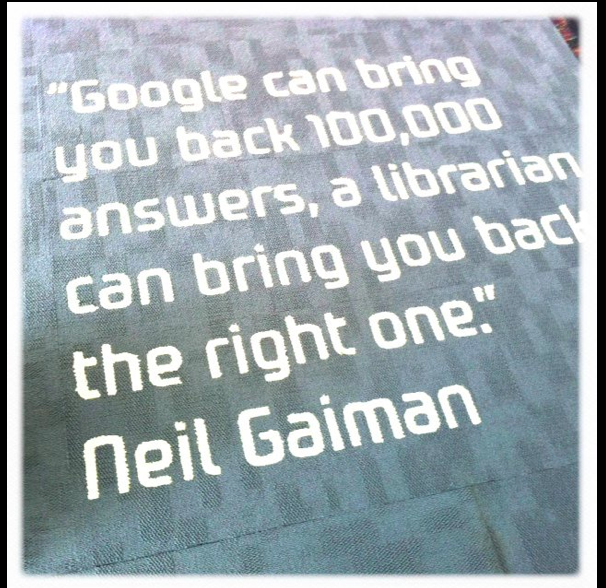
A librarian can bring you back the right one
This is the carpet in Canberra's Gunghalin Public Library. Awesome.
Sunday, October 31, 2010
Neil Gaiman in a Tardis - Esoteric much?

I couldn't resist sharing this, even though to properly get it you need to be a geek of four sorts: A Doctor Who geek, a Neil Gaiman geek, an internet geek and a philosophy geek.
Saturday, October 30, 2010
All hallow's read
Neil Gaiman had an idea on his blog. Lots of people liked it and reblogged it, and it became A Thing.
Now I'm joining the bandwagon and encouraging you: give someone a scary book this Halloween. Because Neil's right. There aren't enough book-giving traditions.
There's even a website: allhallowsread.com
I'm going to start by giving this one to my nephew:

Now I'm joining the bandwagon and encouraging you: give someone a scary book this Halloween. Because Neil's right. There aren't enough book-giving traditions.
There's even a website: allhallowsread.com
I'm going to start by giving this one to my nephew:

Thursday, October 21, 2010
Collected thoughts
I have exactly one week left of Honours...
In the meantime, here's a link to a recent interview of Neil Gaiman. One thing he said about comics caught my eye: "It is not a genre. It is simply a medium."
Meanwhile, I've been browsing through a book called Jane Austen: Antipodean Views when my brain can't handle any more study (and sometimes when it can) and was struck by the insight of Tim Flannery, which actually stands out amongst the writings of English Professors, teachers and celebrities:
Something else that's been in my procrastinatory thoughts is how my concept of having 'read a book' is changing as a result of my studies. I used to think that to have read a book I had to begin at page one and read it all the way through. While that still applies to fiction, I just don't think that way about non-fiction anymore. I can say, without a guilty conscience, that I have 'read' a non-fiction book as long as I feel I've read all the interesting and relevant bits.
Don't tell me I'm cheating. I am maximising my time.
In the meantime, here's a link to a recent interview of Neil Gaiman. One thing he said about comics caught my eye: "It is not a genre. It is simply a medium."
Meanwhile, I've been browsing through a book called Jane Austen: Antipodean Views when my brain can't handle any more study (and sometimes when it can) and was struck by the insight of Tim Flannery, which actually stands out amongst the writings of English Professors, teachers and celebrities:
One of the most significant evolutionary forces currently acting is sexual selection. Women are much more selective than men, and the sort of trade-offs and carefully calculated estimations of worth of men in various capacities elucidated by Austen is, in some ways, as fine an evolutionary study as Darwin's, though it is admittedly only a single-species perspective.
Austen also investigates that eternal battleground between the mind and the genes that is humanity's unique affliction. Because the choices women are forced to make in this area are so much more onerous than men's, Austen's insights are piquant indeed.Unfortunately I can't link you to the book. I believe it's out of print.
Something else that's been in my procrastinatory thoughts is how my concept of having 'read a book' is changing as a result of my studies. I used to think that to have read a book I had to begin at page one and read it all the way through. While that still applies to fiction, I just don't think that way about non-fiction anymore. I can say, without a guilty conscience, that I have 'read' a non-fiction book as long as I feel I've read all the interesting and relevant bits.
Don't tell me I'm cheating. I am maximising my time.
Wednesday, September 22, 2010
Um... squee?

Allow me to indulge my feminist and geek sensibilities all at once for a moment. Being proud of my geekdom, I am of course familiar with the term 'fanboy'. For those who aren't, here are a couple of definitions:
Wikipedia- Fanboy is a term used to describe a male who is highly devoted and biased in opinion towards a single subject or hobby within a given field. Fanboy-ism is often prevalent in a field of products, brands or universe of characters where very few competitors (or enemies in fiction, such as comics) exist.
The Urban Dictionary- Fanboy: A passionate fan of various elements of geek culture (e.g. sci-fi, comics, Star Wars, video games, anime, hobbits, Magic: the Gathering, etc.), but who lets his passion override social graces.
I was thinking about the term 'fanboy' the other day, and began to wonder if there was a 'girl' version of the term. Lo and behold, there is. I can't help noticing, however, that the definitions of 'fanboy' and 'fangirl' seem a little uneven. Note, from the very same sources:
Wikipedia- The term fangirl can be used to describe a female member of a fandom community (counterpart to the masculine "fanboy"). Fangirls may be more devoted to emotional and romantic aspects of their fandom, especially (relation-)shipping. However, it is commonly used in a derogatory sense to describe a girl's obsession with something, most commonly a male teen idol or an aspect of Japanese pop culture. Fangirl behavior can vary in intensity. On one end of the scale are those that, while harboring a crush on a particular actor or character, are perfectly capable of understanding that the fulfilment of the crush is never going to happen. On the other end are the girls who are said to be obsessive in their claims on a fictional character, even fighting with other fangirls over who 'owns' the character in question.
The Urban Dictionary- Fangirl: A rabid breed of human female who is obesessed with either a fictional character or an actor.
Uh... rabid? Excuse me, give me my term back! I'm a girl, and I'm a fan of lots of things.
I hereby declare myself a non-rabid, non-hormone-driven, passionate, geeky fangirl of the following:
- Neil Gaiman (including, but not limited to, the Sandman comics)
- The Princess Bride (yeah, that's me in the t-shirt)
- The Obernewtyn Chronicles
- The Lord of the Rings films
- Robin Hobb's fantasy worlds
- Narnia
Tuesday, August 17, 2010
NEEEEEEIL! (and also some links)
Just over a week ago I attended 'Graphic', a convention run by the Sydney Opera House. Neil Gaiman was present.
For those of you who weren't lucky enough to attend, here's a video of the reading Neil did on the Saturday night. His reading voice is just divine, but don't take my word for it. Check out the video.
I attended a panel discussion with Neil, Shaun Tan and Eddie Campbell the following day, and got to ask Neil a question I've been pondering a while. It was a wonderful weekend. =D
Now I'm back to study, and have found myself quite motivated to write by this rather old TIME interview of Neil and Joss Whedon (by none other than Lev Grossman).

In some unrelated thoughts, I've been thinking about how having an ereader changes my reading experience. Just this morning, a friend mentioned that he'd found an underlined sentence in a book I've loaned him. I've always been very aware of books as physical objects. I don't just read them, I use them. I love the portability of ebooks, but I do occasionally miss the ability to mark a page with a ticket stub or write my thoughts in the margins. And voila, I logged onto one of my favourite blogs today and found this link, in which Sam Jordison discusses books-as-archives.
For those of you who weren't lucky enough to attend, here's a video of the reading Neil did on the Saturday night. His reading voice is just divine, but don't take my word for it. Check out the video.
I attended a panel discussion with Neil, Shaun Tan and Eddie Campbell the following day, and got to ask Neil a question I've been pondering a while. It was a wonderful weekend. =D
Now I'm back to study, and have found myself quite motivated to write by this rather old TIME interview of Neil and Joss Whedon (by none other than Lev Grossman).

Friday, June 25, 2010
A bit of news and some wonderful links
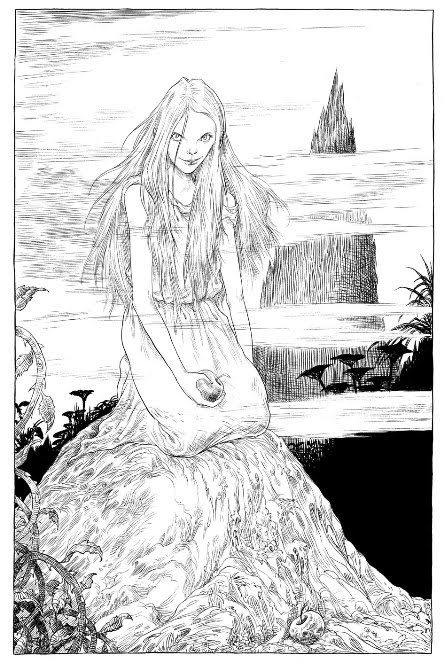 For those of you who, a couple of posts ago, said "Huh? Who's Neil Gaiman?", I have this piece of news: Mr. G is now the only author to be awarded both the CILIP Carnegie Medal and the Newbery Medal for the same book. The medals are awarded in the UK and the US respectively, for the best children's book of the year. This year's winner for both was The Graveyard Book. You can read more here.
The picture shown here is one of my favourite illustrations from the book.
FYI, he has been the recipient of numerous awards in the past, including the World Fantasy Award (the first author to receive it for a comic) and the Hugo Award for Best Novel.
Also, I thought it about time that I shared a wonderful ebook link I've found: make sure you check out Inkmesh. It's a search engine for ebooks. It's invaluable for finding those ebooks which are difficult to track down- last night I finally found L.M. Montgomery's Emily trilogy in an electronic format. It also lists prices and available formats alongside each site which supplies the ebook, cutting down on time-consuming online searches.
It's so useful, in fact, that I've added it to my page of (Actually) Useful book links.
Thursday, June 17, 2010
The one where I gush about Neil Gaiman and think about the rebirth of the author
So if you don't already know that I'm a Neil Gaiman fan, welcome to my blog for the very first time. Those of you that have been here before will understand that when I bought tickets yesterday to seem him in Sydney in August I was BESIDE MYSELF. At work yesterday, I kept saying "I'm going to see Neil Gaiman!" to anyone who would listen (and quite a few people who wouldn't).
I'm not the sort to be star-struck. I think Neil is probably the only person on the planet who could send me into a fluster. I've already started stressing about what I will say if, for some reason, I have the opportunity to shake his hand at one of the events I'm attending. A man as talented as Mr. Gaiman hears strangers tell him how much they appreciate his work all the time.
If you haven't heard of him before, you'll have to take my word for it. His writing talent and his imagination are awe-inspiring, and he has a cult following of over a million fans worldwide. His creativity is matched only by a kind of intellectual rigour rarely found outside academia. When you read a work by Neil Gaiman, you know you are in the presence of a keen awareness of mythology and tales most of us have long forgotten. I think it's telling that a quote from his Sandman comics was recently misattributed to Shakespeare. I'd like to gush some more but I won't, because a.) I would probably bore you and b.) Charlie Orr has already said it anyway.

Neil has said in interviews that Stardust was partly inspired by The Princess Bride- or by a lack of book similar to The Princess Bride. Both are fairy tales sold primarily to an adult audience, and they have a similar humour about them. Both were made into films with plotlines more romanticised than those in the original books.
There is, however, one significant difference: The Princess Bride is metafictional. Goldman continually interrupts the story to say what he thinks of it, and this is part of the story. He talks about his wife and son, their reactions to the text and the process of abridging the original text of The Princess Bride. This is all part of the fiction, though Goldman mixes in enough truth to confuse the reader a little.
I've been thinking about this because I'm writing my Honours thesis on a certain philosophical problem regarding fiction, and I'm using metafiction (specifically The Princess Bride) to illuminate the problem. It occurred to me the other day that while Stardust the text isn't metafictional, it was created in a postmodern world where we have access to authors' opinions of their work. Fans interact with Neil all the time, on Twitter or on his blog. They ask him questions about his work and his life and he answers them (though I've never seen him offer an authoritarian interpretation of one of his works).
It's a joy to read, mostly because it's well-written and he's such a nice guy. And it makes me wonder. There are lots of authors with blogs these days. How does this affect they way we see their work? Roland Barthes famously told us that the author is dead. Could it be that when authors enter our online communities and interact directly with the fans of their work, the author is reborn? Not as a authoritative figure, but as a member of the community discussing the work he happened to create.
Friday, May 21, 2010
IF YOU READ THIS BOOK THE WORLD WILL END
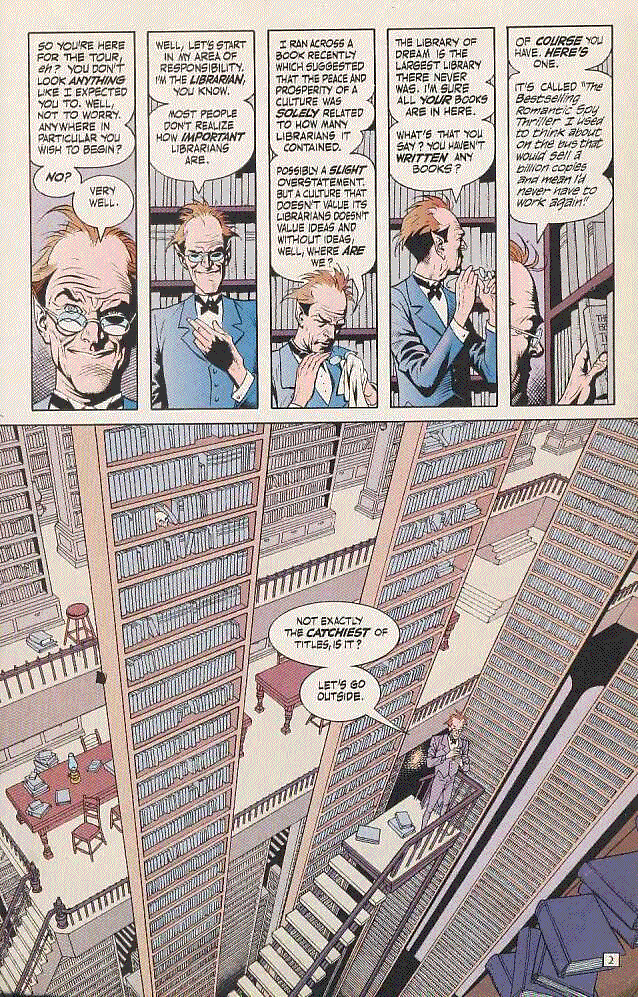 The Hypothetical Library is a blog by cover artist Charlie Orr. The project is fascinating: he asks authors to give a title and a description of a book they could write, but never will write, and then designs the covers and posts them.
When I first came across The Hypothetical Library, I thought 'That reminds me of the libary in the Dreaming, from the Sandman comics.' This library contains not just every book ever written, but also every book ever intended. It's one of my favourite things about the Sandman series. (Click on the image to see what I mean.)
As it turns out, I was right: The Hypothetical Library was actually partly inspired by the library in the Dreaming.
Now, Orr has actually designed a book for Neil Gaiman (with audio and e-book versions to come). The book is entitled If You Read this Book the World Will End. It looks as if the world actually would end, too. You can view the post here.
Monday, May 17, 2010
Something of a filler
It occurred to me that I should alert you to the fact that posts this month are (and will be) few and mostly likely not very substantial. This is because the final two weeks of the semester are upon me. I know my priorities. =)
In the meantime, I was sneaking in some Black Books last night and noticed something of a resemblance between two of my favourite book-related people:


If you haven't seen any of Black Books and you are in possession of a sense of humour, I suggest you do yourself a favour and watch some. And by possessing a sense of humour, I mean that you have laughed at one of the following:
a.) The Princess Bride
b.) Monty Python and the Holy Grail
c.) Something by Terry Pratchett and/or Douglas Adams
Edit: A friend has pointed out that I failed to note that the dashing gentleman on the left is Dylan Moran of Black Books, and the charming one on the right is Mr. Neil Gaiman.
Friday, April 9, 2010
Instructions Book Trailer
Have you heard of book trailers?
I hadn't, either, until I stumbled across a reference to them on another blog recently. Which makes you wonder: what's the point?
Anhyhow, here's the trailer from HarperKids for the latest Gaiman / Vess collaboration, a picture book entitled Instructions. (The Australian release is next month. I can't wait. Have I mentioned that I collect picture books?)
View on fishpond: Instructions
I hadn't, either, until I stumbled across a reference to them on another blog recently. Which makes you wonder: what's the point?
Anhyhow, here's the trailer from HarperKids for the latest Gaiman / Vess collaboration, a picture book entitled Instructions. (The Australian release is next month. I can't wait. Have I mentioned that I collect picture books?)
View on fishpond: Instructions
Tuesday, March 30, 2010
Hair and influence

You've got to love these t-shirt designs from Hirsute History. I'm considering getting the Neil Gaiman one...
Tuesday, March 23, 2010
Stardust: Child vs. Adult
I've just been listening to a podcast found here about Neil Gaiman's Stardust. Most of the discussion in the podcast revolves around what makes the book a 'fairytale for adults'.
Stardust, as you know, is one of my favourite books. Gaiman describes the premise of the book:
"I wanted a young man who would set out on a quest - in this case a romantic quest, for the heart of Victoria Forester, the loveliest girl in his village. The village was somewhere in England, and was called Wall, after the wall that runs beside it, a dull-looking wall in a normal-looking meadow. And on the other side of the wall was Faerie - Faerie as a place or as a quality, rather than as a posh way of spelling fairy. Our hero would promise to bring back a fallen star, one that had fallen on the far side of the wall.
"And the star, I knew, would not, when he found it, be a lump of metallic rock. It would be a young woman with a broken leg, in a poor temper, with no desire to be dragged halfway across the world and presented to anyone's girlfriend."
In the same article, Gaiman mentions that he loved The Princess Bride when he was young, and wrote Stardust with the wish of creating another story that was "unapologetically a fairytale, and just as unapologetically for adults."
Much of the podcast discussion revolves around the single sex scene and the single swear word found in Stardust. Are these what make the novel one for adults? Or are they just the elements which make adults able to claim a fairytale as their own without embarrassment?
Stardust, as you know, is one of my favourite books. Gaiman describes the premise of the book:
"I wanted a young man who would set out on a quest - in this case a romantic quest, for the heart of Victoria Forester, the loveliest girl in his village. The village was somewhere in England, and was called Wall, after the wall that runs beside it, a dull-looking wall in a normal-looking meadow. And on the other side of the wall was Faerie - Faerie as a place or as a quality, rather than as a posh way of spelling fairy. Our hero would promise to bring back a fallen star, one that had fallen on the far side of the wall.
"And the star, I knew, would not, when he found it, be a lump of metallic rock. It would be a young woman with a broken leg, in a poor temper, with no desire to be dragged halfway across the world and presented to anyone's girlfriend."
In the same article, Gaiman mentions that he loved The Princess Bride when he was young, and wrote Stardust with the wish of creating another story that was "unapologetically a fairytale, and just as unapologetically for adults."
Much of the podcast discussion revolves around the single sex scene and the single swear word found in Stardust. Are these what make the novel one for adults? Or are they just the elements which make adults able to claim a fairytale as their own without embarrassment?
Monday, March 22, 2010
A new favourite
I blogged about my favourite books here, but alas, the list is now out of date. I've added Good Omens, by Terry Pratchett and Neil Gaiman, to my list of favourite-ever books.
I wrote about Good Omens here. I really can't praise the book highly enough.
And I am rather excited to have found some wonderful fan art, here on deviantART. Do yourself a favour and check it out. It's beautiful art, and it's an excellent recommendation for the book.

View on fishpond: Good Omens
I wrote about Good Omens here. I really can't praise the book highly enough.
And I am rather excited to have found some wonderful fan art, here on deviantART. Do yourself a favour and check it out. It's beautiful art, and it's an excellent recommendation for the book.

View on fishpond: Good Omens
Tuesday, January 26, 2010
This is my favourite book in all the world
I'm currently rereading The Princess Bride, and I'd forgotten how much I loved it. Actually I'm going to spend my whole year loving it (I hope), because I get to write my Honours thesis on it. I'm a little excited about the project.
Anyway, rereading one of my favourite books made me realize that I've never shared my favourites on here. So, here they are:
The Princess Bride by William Goldman
I love this book because of its playfulness and its truth. I love so many of the characters- Inigo, the vengeful Spaniard, is my favourite. How can you not love the dialogue? (Much of which is in the film. Don't tell me you haven't seen the film. You'll break my heart.) And how can you not love Goldman for continually taking the piss out of his own work?
This book is pure satire, in all its sarcastic, entertaining glory.
First line: "This is my favourite book in all the world, though I have never read it."
The Emily series by L.M. Montgomery
I first read these when I was seven years old. If there are any books which define me, these are it. I quote these books continually, I've internalised them. They're by the author of Anne of Green Gables, but where Anne is flamboyant and loud, Emily is dreamy and intense. She lives in a world where fairies are always seconds away and words shape our existence.
Quote: "there is something BEYOND words--any words--all words--something that always escapes you when you try to grasp it--and yet leaves something in your hand which you wouldn't have had if you hadn't reached for it."
The Liveship Traders trilogy by Robin Hobb
I have never met characters who seemed more real. They step off the page. They learn, they grow, they ache. Robin Hobb allows her characters to go through things most authors would cringe at, and she allows them to be truly flawed (no 'token flaws' here).
And whaddayaknow? Their confused and flawed actions shape history in ways that you couldn't have guessed, yet seem just as real and inevitable as any human history.
Epic fantasy which is entitled to take itself seriously.
Girl in Hyacinth Blue by Susan Vreeland
This book is a collection of short stories about a single painting. A beautiful exploration of the ways in which art touches us, changes us and commemorates our passions. Girl in Hyacinth Blue gives us the history of a painting (possibly a Vermeer) through the lives of the people who admired its beauty, from the man who destroyed it to the girl who posed for it.
Stardust by Neil Gaiman and Charles Vess
Sparkling and funny. Fantastical and unsettling. Brilliant.

Anyway, rereading one of my favourite books made me realize that I've never shared my favourites on here. So, here they are:
The Princess Bride by William Goldman
I love this book because of its playfulness and its truth. I love so many of the characters- Inigo, the vengeful Spaniard, is my favourite. How can you not love the dialogue? (Much of which is in the film. Don't tell me you haven't seen the film. You'll break my heart.) And how can you not love Goldman for continually taking the piss out of his own work?
This book is pure satire, in all its sarcastic, entertaining glory.
First line: "This is my favourite book in all the world, though I have never read it."
The Emily series by L.M. Montgomery
I first read these when I was seven years old. If there are any books which define me, these are it. I quote these books continually, I've internalised them. They're by the author of Anne of Green Gables, but where Anne is flamboyant and loud, Emily is dreamy and intense. She lives in a world where fairies are always seconds away and words shape our existence.
Quote: "there is something BEYOND words--any words--all words--something that always escapes you when you try to grasp it--and yet leaves something in your hand which you wouldn't have had if you hadn't reached for it."
The Liveship Traders trilogy by Robin Hobb
I have never met characters who seemed more real. They step off the page. They learn, they grow, they ache. Robin Hobb allows her characters to go through things most authors would cringe at, and she allows them to be truly flawed (no 'token flaws' here).
And whaddayaknow? Their confused and flawed actions shape history in ways that you couldn't have guessed, yet seem just as real and inevitable as any human history.
Epic fantasy which is entitled to take itself seriously.
Girl in Hyacinth Blue by Susan Vreeland
This book is a collection of short stories about a single painting. A beautiful exploration of the ways in which art touches us, changes us and commemorates our passions. Girl in Hyacinth Blue gives us the history of a painting (possibly a Vermeer) through the lives of the people who admired its beauty, from the man who destroyed it to the girl who posed for it.
Stardust by Neil Gaiman and Charles Vess
Sparkling and funny. Fantastical and unsettling. Brilliant.

Monday, January 4, 2010
Neil Gaiman's Sandman

I've been a fan of Neil Gaiman for a couple of years now, so when I made the decision a few months ago to start reading more comics it seemed natural to start with the Sandman. I really didn't expect to enjoy them so much.
The series's main protagonist is Dream (aka Morpheus/the Sandman), lord of the realm of dreams (and stories). It begins with Dream being captured by humans, and the hideous consequences which occur when mortals meddle in such things.
I've enjoyed later installments even more than the first one. The character that's really captured my attention is Dream's older sister, Death. She's just so... well, for starters, she's hot. But she's also cute, and rather lovable. When she turns up to chat with the recently deceased, why wouldn't they want to go with her?
The treatment of death as something to embrace (not before one's time, but as a natural part of life) is common theme in Gaiman's work, and one I like.
For now, I'm ordering the fourth volume of the Sandman from Minotaur, a brilliant store in Melbourne which sells all kinds of wonderful things related to pop culture and cult followings.
Monday, December 28, 2009
In the beginning...
I was lucky enough to receive The Doll's House, volume 2 of Neil Gaiman's Sandman comics, for Christmas. Yippee!
Mr. G begins the volume with the following paragraphs:
"In the beginning...
"But of course we never see the beginning. We come in the middle, after the lights have gone down, and try to make sense of the story so far. Whisper to our neighbours 'Who's he? Who's she? Have they met each other before?'
"We get by."
What an insightful reflection on stories, fictitious and non-fictitious alike.
Mr. G begins the volume with the following paragraphs:
"In the beginning...
"But of course we never see the beginning. We come in the middle, after the lights have gone down, and try to make sense of the story so far. Whisper to our neighbours 'Who's he? Who's she? Have they met each other before?'
"We get by."
What an insightful reflection on stories, fictitious and non-fictitious alike.
Thursday, December 10, 2009
Highlights '09
I'm subscribed to quite a few book blogs and book news feeds. At this time of year, a lot of 'best of ' and 'highlights' lists start coming through, pointing readers to the best books of the year. But the problem with book news is that it's all about new realeases. I started reading books towards the end of the 20th Century- I have the whole history of print to catch up on!
So these are (some of) the highlights of my '09 reading:
January - four weeks off in Toowoomba and Brisbane
-The History of Western Philosophy, Bertrand Russell (1946)
A fascinating look at a fascinating topic
-The Amazing Maurice and His Educated Rodents, Terry Pratchett (2001)
A magically intelligent cat and clan of rats figure there's always money to be made in faking rat plagues.
March-April - Semester 1
-Beginning Logic, E. J. Lemmon (1965)
An excellent guide to formal logic. I read it for uni, and it rocked my socks!
March 31- I meet Shaun Tan and a friend leaves the country
-The Arrival, Shaun Tan (2006)
A gorgeous graphic novel about the strangeness and beauty of immigration. I cried.
June - cruising on the Nile in Egypt
-I was reading, but I don't quite remember what. The view was distracting me. =P
June/July - London & Oxford, England; and Wicklow, Ireland
-The Inkworld trilogy, Cornelia Funke (2003, 2005, 2007)
Because you have to read fantasy in Oxford.
July - a very long flight home
-The Ghost, Robert Harris (2007)
A surprisingly engaging modern thriller from a historical novelist.
August-October - Semester 2
-The Graveyard Book, Neil Gaiman (2008)
Brilliant. =)
-The Magicians, Lev Grossman (2009)
Equally brilliant. =)
mid-September - an awful sickness strikes
-Sense and Sensibility, Jane Austen (1811)
Thus completing my aim to read all of Austen's novels.
November-December - mixing up my reading habits
-Preludes and Nocturnes, Neil Gaiman (1988/1989)
The first installment of the classic Sandman comics. An excellent read.
-Good Omens, Neil Gaiman and Terry Pratchett (1990)
Read it.
(As always, I've posted links to authors' sites where possible. It's not my fault if their sites aren't helpful. Where these weren't available, I've posted links to the best information I can find about the book. Sometimes this means Amazon.)
So these are (some of) the highlights of my '09 reading:
January - four weeks off in Toowoomba and Brisbane
-The History of Western Philosophy, Bertrand Russell (1946)
A fascinating look at a fascinating topic
-The Amazing Maurice and His Educated Rodents, Terry Pratchett (2001)
A magically intelligent cat and clan of rats figure there's always money to be made in faking rat plagues.
March-April - Semester 1
-Beginning Logic, E. J. Lemmon (1965)
An excellent guide to formal logic. I read it for uni, and it rocked my socks!
March 31- I meet Shaun Tan and a friend leaves the country
-The Arrival, Shaun Tan (2006)
A gorgeous graphic novel about the strangeness and beauty of immigration. I cried.
June - cruising on the Nile in Egypt
-I was reading, but I don't quite remember what. The view was distracting me. =P
June/July - London & Oxford, England; and Wicklow, Ireland
-The Inkworld trilogy, Cornelia Funke (2003, 2005, 2007)
Because you have to read fantasy in Oxford.
July - a very long flight home
-The Ghost, Robert Harris (2007)
A surprisingly engaging modern thriller from a historical novelist.
August-October - Semester 2
-The Graveyard Book, Neil Gaiman (2008)
Brilliant. =)
-The Magicians, Lev Grossman (2009)
Equally brilliant. =)
mid-September - an awful sickness strikes
-Sense and Sensibility, Jane Austen (1811)
Thus completing my aim to read all of Austen's novels.
November-December - mixing up my reading habits
-Preludes and Nocturnes, Neil Gaiman (1988/1989)
The first installment of the classic Sandman comics. An excellent read.
-Good Omens, Neil Gaiman and Terry Pratchett (1990)
Read it.
(As always, I've posted links to authors' sites where possible. It's not my fault if their sites aren't helpful. Where these weren't available, I've posted links to the best information I can find about the book. Sometimes this means Amazon.)
Wednesday, December 2, 2009
Good Omens & The Finn Family Moomintroll
I have recently being trying to mix up my reading habits to include different mediums. A few weeks ago I thoroughly enjoyed the visual challenge of reading some comics- but that's another post. Another medium I've been trying is audio. It's been years since I have listened to an audio book (I did listen to them quite frequently as a child), and I'd forgotten what a heady experience it is.
Recently, I've been listening to two audio books.
The first is The Finn Family Moomintroll, written by Tove Jansson and read by the incredibly talented Hugh Laurie. The Moomin stories were favourites of mine as a child, and it has been a rather magical experience (albeit strange, with childhood memories popping up all over the place) to hear Hugh Laurie perfectly represent each character with a different 'voice'.
Find out more about the Moomins here.
The second audio book in question is Good Omens, written by Neil Gaiman and Terry Pratchett (oh why, oh why have they never worked together since!?), and read by Stephen Briggs. If you never read any other comic fantasy, read Good Omens. Or better yet, allow Stephen Briggs to read it to you.
The story is both hilarious and thought-provoking. It follows Aziraphale, an angel, and Crowley, a demon (or an angel "who did not so much Fall as Saunter Vaguely Downwards"), unlikely partners in crime who face impending Armageddon and realize that they've come to like Earth the way it is, really. There are many other characters you won't soon forget, many of them endearing. (Read more about the book at Gaiman's webiste, here.)
Stephen Briggs lends to all this an actor's talent, giving different characters distinct voices and often making me chuckle out loud as I sit and listen through my earphones.
I can't recommend it highly enough. Buy it for someone this Christmas. Or buy it for yourself. You deserve it, right?

Recently, I've been listening to two audio books.
The first is The Finn Family Moomintroll, written by Tove Jansson and read by the incredibly talented Hugh Laurie. The Moomin stories were favourites of mine as a child, and it has been a rather magical experience (albeit strange, with childhood memories popping up all over the place) to hear Hugh Laurie perfectly represent each character with a different 'voice'.
Find out more about the Moomins here.
The second audio book in question is Good Omens, written by Neil Gaiman and Terry Pratchett (oh why, oh why have they never worked together since!?), and read by Stephen Briggs. If you never read any other comic fantasy, read Good Omens. Or better yet, allow Stephen Briggs to read it to you.
The story is both hilarious and thought-provoking. It follows Aziraphale, an angel, and Crowley, a demon (or an angel "who did not so much Fall as Saunter Vaguely Downwards"), unlikely partners in crime who face impending Armageddon and realize that they've come to like Earth the way it is, really. There are many other characters you won't soon forget, many of them endearing. (Read more about the book at Gaiman's webiste, here.)
Stephen Briggs lends to all this an actor's talent, giving different characters distinct voices and often making me chuckle out loud as I sit and listen through my earphones.
I can't recommend it highly enough. Buy it for someone this Christmas. Or buy it for yourself. You deserve it, right?

Subscribe to:
Posts (Atom)

